Airedale Highlights Free Cooling for Data Centres: PUEs of 1.1 Possible

Airedale is highlighting the scope for free cooling systems to reduce energy consumption and operational costs in data centres, suggesting that PUEs of 1.1 or below are achievable. Airedale's promotion of free cooling technology for data centres underscores the increasing importance of energy-efficient solutions, as operational costs and sustainability drive innovation. The company says that free cooling units can pay for themselves within one to two years, potentially halving total ownership costs compared to traditional DX systems within five years.
Concurrent Cooling and System Optimisation
The core concept involves using external ambient temperature to dissipate heat, thereby reducing or eliminating the need for mechanical refrigeration. Airedale emphasises its pioneering work in ‘concurrent’ free cooling in data centres for over 20 years, designed to maximise the part-load efficiencies of components such as EC fans and inverter-driven pumps.
Concurrent free cooling refers to systems where both mechanical and free cooling operate simultaneously for optimised efficiency.
These components adjust cooling output to match the load, minimising energy wastage and wear. According to Airedale, EC fans can be up to 70% more efficient than AC fans at partial load. Airedale's Cooling System Optimiser™ can manage between two and twenty chillers, optimising performance across the cooling block. The system aims to maximise free cooling utilisation while maintaining stable water conditions. Furthermore, the company suggests that raising supply and return temperatures – to 24°C and 36°C, respectively – can generate additional free cooling opportunities without compromising computer room functionality. Notably, these temperatures are still well within ASHRAE's recommended upper operating temperature of 27°C (80.6°F) for data centres.
To further enhance energy management, Airedale advocates for the integration of free cooling HVAC systems with comprehensive Building Management Systems (BMS) like the Air. These systems allow for monitoring and management of HVAC, lighting, and other power units, deploying optimised operating settings to maximise free cooling and reduce energy costs. Airedale’s HVAC optimization claims to leverage years of experience in designing HVAC systems. The company also notes that setting fans to operate at 80% capacity can reduce energy consumption by up to 50% without compromising performance.
The largest power draw on any cooling system is the compressor. Even slight reductions in compressor running time, operating capacity, or operating conditions can have significant effects on the power consumption of the system. If used within an optimised system, free cooling can provide significant energy savings. It can take effect when the difference between the outside supply and return temperatures is as little as 1°C. This means that, in a 24/7 data centre with a typical room temperature of 24°C, over 95% of the year can be spent with free-cooling active.
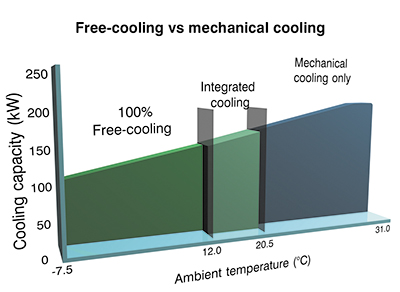
In terms of the costs of ownership, energy represents by far the biggest item of expenditure, often outweighing the initial capital costs over the course of a unit’s lifetime; in the case of a traditional DX computer room air conditioning (CRAC) system, estimated energy costs over the course of five years can add up to 5 or 6 times the initial cost of the unit. Free cooling units can easily pay for themselves within the first 1 to 2 years and, by the end of five years, total costs of ownership can equate to around half those of DX systems. Free cooling opportunities can therefore make a significant saving on operational budgets, generating PUEs of 1.1 or below. Energy can be reduced further by setting fans to operate at less than full capacity without compromising performance at full load; under Fan Affinity Law, a fan working at up to 80% of capacity for example will reduce energy consumption by up to 50% for the same performance.
Coupling a free cooling HVAC system with a comprehensive Building Management System (BMS) like the Air can save significant operational budgets, generating PUEs of 1.1 or below.